
Following is the reaction of parties on the India-specific safeguards agreement being approved by the Board of Governors of the International Atomic Energy Agency.
India has received a positive response from the Non-Aligned Movement countries, which are members of the International Atomic Energy Agency and the Nuclear Suppliers Group on the Indo-US nuclear deal after it briefed them on the safeguards agreement, which the global nuclear watchdog will consider on Friday.
The delegations is expected to discuss the progress of two VVER-1000 (1000 MW each) plants, which will be commissioned soon, with Indian officials led by NPCIL Chairman and Managing Director S K Jain. They will also discuss the progress made on eight more proposed Russian reactors for India, Nuclear Power Corporation of India Limited sources said.
The safeguards pact, which is the next step in the operationalisation of the Indo-US civil nuclear deal, was sent to the 35-nation Board on a day when the Left parties formally withdrew support from the United Progressive Alliance government, following a bitter feud over the deal which has remained stalled for several months.
The government believes that the matter should remain within the jurisdiction of the International Atomic Energy Agency and not be referred to the United Nations Security Council.
"The effort was rewarded with the discovery of a large number of sites, which have indicated their potential for hosting uranium reserves," it said, quoting a latest official document.
Former foreign secretary Shyam Saran says he is "optimistic" of the nuclear deal being cleared at the Nuclear Suppliers Group meeting. Saran -- the prime minister's special envoy on climate change and the India-US nuclear civilian agreement -- also confirmed that Prime Minister Manmohan Singh will attend the G-8 summit in Tokyo later this week.
The government on Wednesday ruled out giving to the Left the draft of the India-specific Internatonal Atomic Energy Agency safeguards agreement in connection with the Indo-US nuclear deal, but asserted that all their queries on this subject have been "answered." "It is not possible to give them (Left) the (safeguards) text. We have anwsered all their queries," Union Science Minister Kapil Sibal told TV channels.
External Affairs Minister Pranab Mukherjee on Wednesday advised the United States to leave the issue of Iran's nuclear programme to the International Atomic Energy Agency and not take up the responsibility of deciding Iran's position."Iran should convince the IAEA that their nuclear programme is for peaceful purposes. We are advising Iran that being a signatory of the Non-Proliferation Treaty, you should satisfy the IAEA."
The Russian government-owned company will be setting up eight to ten plants at Kudankulam in Tamil Nadu and Haripur in West Bengal over the next two decades under the Indo-Russian civil nuclear agreement, and the proposed fabrication plant will be supplying fuel to these plants, TVEL executive director for communications and public affairs Ivan Dybov said in Mumbai.
IAEA director general Muhamad ElBaradei expressed the hope for a long-term comprehensive agreement, which would allow for the development of relations and cooperation with Iran.
The police is yet to trace the origin of Cobalt-60, the radioactive material that caused serious injuries to six persons and are awaiting the recovery of the owner of the scrap shop from where it was found three days ago to get more clarity.
Key provisions of the Indo-US nuclear deal.
T P Sreenivasan, India's former Governor to the International Atomic Energy Agency and ex-Indian Ambassador to the United Nations in Vienna, has predicted that the Indo-US civilian nuclear deal will be honoured regardless of whatever dispensation comes to power following the general election in May. Sreenivasan noted that "two of the three coalitions vying for power in India are committed to amend it, though not to abandon it."
The much-debated Nuclear Liability Bill, crucial for operationalising the India-US civil nuclear deal, would be tabled in the Rajya Sabha on March 15, Minister of State for Atomic Energy Prithviraj Chavan has said.
"India is capable of indigenously building the most viable commercial nuclear reactors for producing 220 MW and 540 MW power. Small reactors are the best bet to export," he told media persons at the Koodamkulam Nuclear power plant site near Tirunelveli replying to a question on feasibility of exporting nuclear reactors to countries like Egypt.
External Affairs Minister Pranab Mukherjee rejected suggestions that the United Progressive Alliance government's capacity to operationalise the deal has weakened after the Congress' debacle in Gujarat and Himachal Pradesh assembly elections. "We would not like to proceed with the deal if the Left parties withdraw support from the government," he told Karan Thapar's India Tonight programme on CNBC.
India hopes to wrap up a safeguards agreement with the International Atomic Energy Agency later this month in Vienna, before approaching the Nuclear Suppliers Group, for changes to permit international nuclear commerce. India needs to reach a safeguards agreement and then get the nod of the 45-member NSG for operationalising the India-United States civil nuclear agreement.
"If we remain dependent on foreign technologies, we can never become world leaders and we cannot survive the global competition unless we achieve global leadership at least in some areas where we have strength," Kakodkar said at the convocation of Pt Ravi Shankar Shukla University in Raipur.
"There is no denying the fact that we voted against Iran at IAEA. The intention was to ensure that its nuclear issue does not go to the Security Council as it would entail sanctions and more problems," External Affairs Minister Pranab Mukherjee said while rejecting allegations that India's foreign policy was being affected by the Indo-US nuclear deal.
The European Union is following with great interest India's discussions with the International Atomic Energy Agency on the civilian nuclear agreement and will take a decision on supporting India at the Nuclear Suppliers Group after studying all the developments.
The safeguards issue is unlikely to come up at Thursday's meeting of IAEA's Board of Governors and will come up for approval at a special Board meeting later. IAEA Director General Mohamed El-Baradei and Atomic Energy Commission chairman Anil Kakodkar initiated the talks.
France on Thursday said it wanted to increase civil nuclear cooperation with India, but only after New Delhi implemented the legal framework. ''We want to move further, but first we need India to sign an agreement with the nuclear watchdog, International Atomic Energy Agency, and also to negotiate the exemption agreement with the Nuclear Suppliers' Group,'' visiting French Minister for Higher Education and Research Valerie Pecresse told a press conference in New Delhi.
The Centre is reviewing the security measures at nuclear power plants across the country, in the wake of the recent terror strikes in Mumbai, Atomic Energy Commission Chairman Anil Kakodkar said on Thursday."Several security measures have already been put in place. We are reviewing in the context of what happened in Mumbai and certainly whatever additional (security), which are necessary, we will put in place," he said.
The Hyde Act, signed into law by President Bush in December last year, grants the President authority to waive certain sections of the Atomic Energy Act of 1954 and the 1978 Nuclear Nonproliferation Act

US Congress fires first salvo on the eve of ElBaradei's visit to India and even before the 123 Agreement is presented to NSG, presents laundry list of concerns in legislation.
Investigators have revealed that an 'insider' is involved in the contamination of drinking water at the Kaiga nuclear plant in Karwar, Karnataka, and that they were questioning 10 people from the set-up in this regard.
India on Friday said it could not ignore the conclusions of the International Atomic Energy watchdog IAEA on Iran's nuclear enrichment programme before deciding to vote against Tehran, but felt the door for dialogue with it should be open.
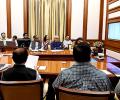
The Centre has taken a major step towards increasing efficiency in decision-making by empowering joint secretaries to report to secretaries directly, officials said on Wednesday.
Confirming this, Minister for Information and Broadcasting Priya Ranjan Dasmunsi said, "Before the meeting started, the amendment was withdrawn."
Rock samples analysed in isotope laboratory of the University of Tuebingen in Germany have revealed uranium content to be as high as 5.36 per cent compared to around 0.1 per cent or less in ores present elsewhere in the country.
India will have to request the NSG to relax its restrictions on the transfer of nuclear technology and fuel.
Former Ambassador M K Bhadrakumar on why India must not go ahead with the 123 Agreement with the US
Lauding India's track record on non-proliferation, Japan said it has been a "good boy" despite remaining outside Non Proliferation Treaty regime, but New Delhi should shoulder the responsibility to strengthen the NPT regime.

'They are taking the people of the country for granted.'
